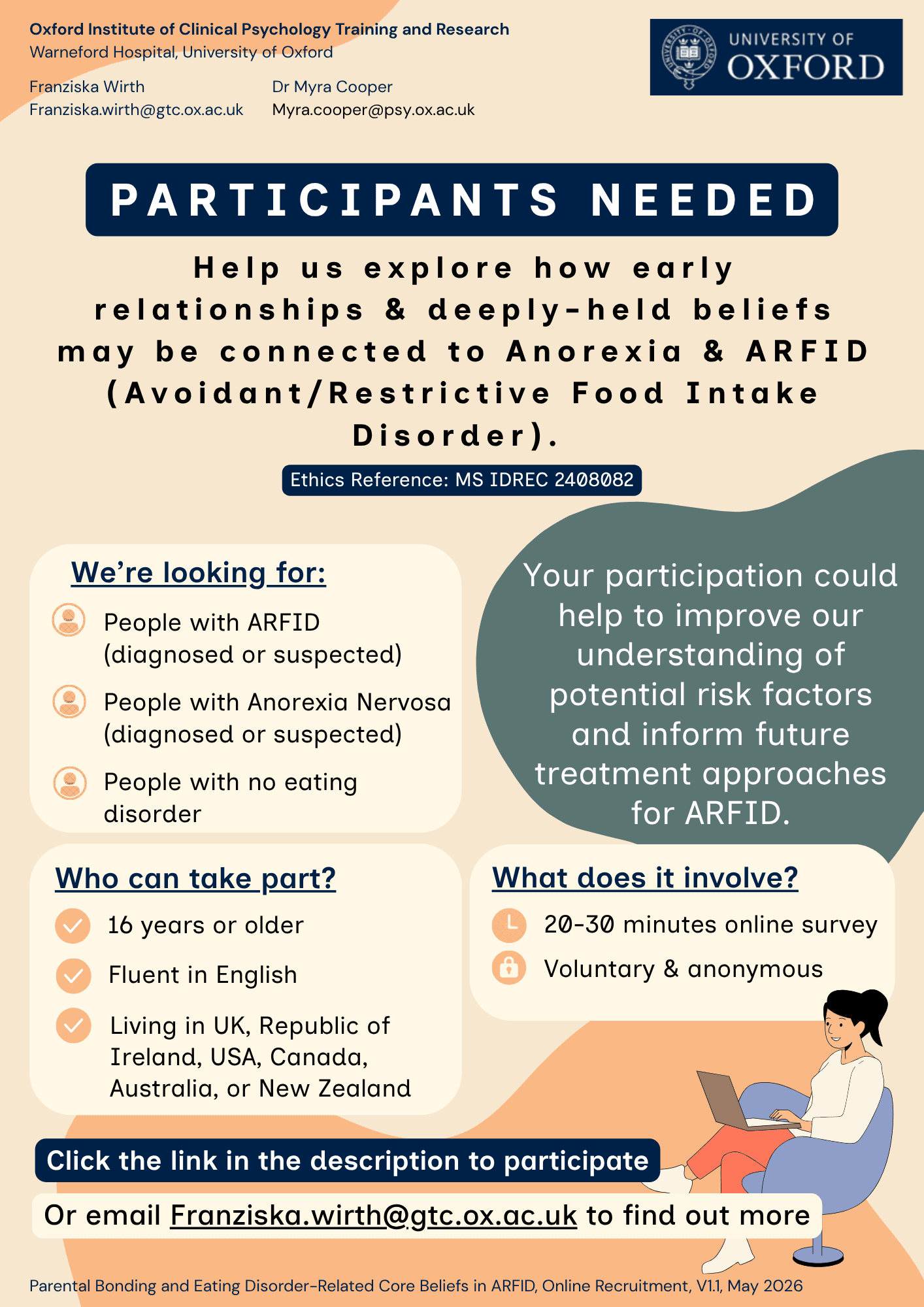
Franziska Wirth, trainee clinical psychologist with the University of Oxford, is conducting a research study exploring eating disorder related core beliefs and parental bonding in those with ARFID and Anorexia Nervosa.
Title: Investigating the Role of Parental Bonding and Eating Disorder-Related Core Beliefs in ARFID (Avoidant/Restrictive Food Intake Disorder)
Background & Aims:ARFID (Avoidant/Restrictive Food Intake Disorder) is a relatively newly established diagnosis. Whilst other eating disorders such as Anorexia Nervosa have been researched for decades, research about the development and treatment of ARFID is still sparse. The aim of this research is to develop an understanding of the role of early bonding experiences with parents/primary carers and the role of eating disorder-related beliefs in ARFID compared to Anorexia Nervosa. It is hoped that this can further the understanding of possible risk factors and inform the development of treatment approaches for ARFID.
As the researchers are seeking to explore potential differences in parental bonding experiences and eating disorder-related beliefs across three groups of people, they are looking for the following participants:
- People with a diagnosis of ARFID or who suspect they might have ARFID.
- People with a diagnosis of Anorexia Nervosa or who suspect they might have Anorexia Nervosa.
- People with no diagnosed or suspected eating disorder.
Individuals with lived experience of Anorexia Nervosa and ARFID have been involved in developing and reviewing the study materials.
Format: This is an online survey. Participants will be asked to fill in seven short questionnaires focusing on their demographic information, eating disorder symptoms, core beliefs, parental/caregiver bonding, and symptoms of anxiety and depression. This will take approximately 20-30 minutes to complete. After completing the questionnaires, participants will be taken to a debrief screen which will provide information on how to reach out for support if required. Participants will also have the option to leave their email address should they wish to be contacted about the study results in the future. Participants will then be able to exit the survey. Participants may withdraw at any point for any reason before submitting their answers by pressing the ‘Exit’ button.
- The survey can be found here
Confidentiality:Participation is anonymous. The researchers will collect participants IP addresses to help determine the integrity of the data. Once this check has been completed, IP addresses will be deleted permanently and there will no longer be any information in the data file that could identify participants. The researchers will take all reasonable measures to ensure that data remain confidential. Participants will have the option to leave their email address at the end of the survey should they wish to be informed about the study results in the future. If they do so, their email address will be stored in a separate file and will not be linked to the survey answers they submitted. The researchers will only use participants’ email addresses to send out a summary of the results and will permanently delete the email address as soon as this has been done.
Participants’ survey responses will be stored in a password-protected electronic file on University of Oxford secure servers and may be used in academic publications and reports for external organisations. All data will be retained for 3 years after the public release of the project in line with Oxford University policy. All information will conform to the 2018 Data Protection Act with respect to data collection, storage, and destruction. Only the research team will have access to your data. The results will be written up for a doctoral thesis.
The researcher can be contacted via email: franziska.wirth@gtc.ox.ac.uk, and their supervisor can be contacted via: Myra.cooper@psy.ox.ac.uk
Ethical approval
The study has received ethical approval from the Medical Sciences Interdivisional Research Ethics Committee at University of Oxford.